Rare Books
Where is Tommy?
Image not available
You might also be interested in
Image not available
Harris, Kirby
Manuscripts
Approx. 45 items. Subjects include: a long series of letters from, early on, Kirby Harris, and later letters, typed and handwritten, mostly from Mrs. (Lorraine) Harris. It seems Mrs. Harris was trying to get chummy with (Otis Chandler and later) Williams. While her letters become increasingly personal, Williams remained professional. Earlier the topics were from the news, later she told of her activities. She eventually sent a photo of herself to him. [?]
mssLAT
Image not available
Indian Legends
Manuscripts
This typescript copy was made for the Harold B. Lee Library "from a typewritten copy loaned to Prof. M. Wilford Poulson of Brigham Young University by Mrs. William Brooks of St. George, Utah. September, 1938." It was originally copied from the handwritten manuscripts by Tony Tillohash which were owned by Ambrose M. Cannon of the Shivwit Indian Reservation in Washington County, Utah. It was loaned by him to the copyist for the Utah State Historical Records Survey Project of the Works Progress Administration of Saint George, Utah. Additional portions of the typescript were obtained by Foster Charles Toab, who also resided on the reservation.
mssHM 66669
Image not available
My own experience with the Vasques Bandits
Manuscripts
This manuscript is Snyder's account of his experiences in the mercantile business in Monterey County, California beginning in 1872. He ran a "branch store" and a "hotell." At length and in detail, Snyder describes an incident where his store was robbed by armed "Spanyards," the leader of whom he names as "Vasques." The bandits shot and killed a partially deaf man when he did not heed their demands for him to submit, and shot a second man hiding in a nearby barn. After killing a third man, Vasques declares that "he had only one way to make a living and that was by robbing, and as long as other people had any money he intended to have his Share of it if he had to kill a man to gett it." The bandits did not kill Snyder because he "submitted." The bandits stole eleven horses, including one that had been a present to Mrs. Snyder, loaded them with the stolen goods, and rode away. Snyder called the aftermath "a Mournfull looking Site." He reports that Vasques was eventually captured in San Jose and hanged. With typewritten card containing a brief biography of Snyder.
mssHM 16695
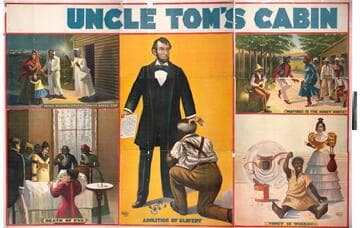
Uncle Tom’s Cabin
Visual Materials
Image of a central image of an older African American man in a torn shirt and suspenders kneeling before Abraham Lincoln who holds a handwritten copy of the “Emancipation Proclamation” with broken shackles at his feet, captioned “Abolition of Slavery”; with an upper-left image of Eliza, a young mother, and a young girl coming to Uncle Tom and his wife, who holds a candle, in their pajamas before their cabin at night, captioned “Eliza seeking protection of Uncle Tom”; a lower-left image of Eva, a young blond girl lying in a small bed with white and African American mourners crowding around the bed and a night stand with a cup, small bottle, and box on it, captioned “Death of Eva”;an upper-right image of an African American man and woman dancing in the front yard of a cabin in a wooded area with African American onlookers and a man playing a banjo, captioned “Pastimes in the sunny South”; a lower-right image of Topsy, a young African American girl wearing a potato sack dress that read “18 [space] CH,” throwing a bonnet while sitting on a messy floor next to a can while a white woman in formal dress looks on aghast; the poster presumably advertises an Uncle Tom’s Cabin show.
priJLC_ENT_002337
Image not available
A country of old men : a Dave Brandstetter novel
Rare Books
"The wear and tear of a life spent pursuing the truth into harm's way is catching up with Dave. In fact, it has already caught him. The aged death claims investigator is old enough for his body to hurt even without all the compiled injuries he's sustained throughout his career. Yet when presented with a puzzle-like mystery, Dave can't help but be drawn in. Walking on the beach, a friend finds a bedraggled child who claims he has witnessed a murder. The victim is a drug-addicted pop star, and the obvious suspect is the dead man's ex-girlfriend--a drug addict whom the child saw standing over the body, gun in hand. In the final installment of Joseph Hansen's groundbreaking series, Dave looks for justice once more, hoping that he will also find a lasting measure of peace. Over the course of twelve novels spanning three decades of American culture--from the 1960s to the late 1980s--Joseph Hansen gave readers one of the truly great heroes of detective fiction"--Back cover.
642335
Image not available
Swift, Jonathan. "Your mouldring walls are mending still" [with other verse]
Manuscripts
Swift is the attributed author of an untitled poem on the last page beginning "Written by Dean Swift in Chester 1725 / Your mouldering walls are mending still..." Also contains eight other ballads and poems associated with Swift, dated 1724 ("A Dialogue between the old Gent that looks over Lincoln and the old Gent on ye new Church in Bloomsbury"; "An Epistle from Jack Sheppard to the E--l of M-----d"; "When York to Heave lifts one solemn Eye..."; "A New Ballad occasioned by a late Edict of the Pope for taxing & limiting the publick stews at Rome, Tune, You fair Ladies."; "Upon the Death of Mrs. Bowes who dyed in ten weeks after she was married." ; "By the Lord Harvey"; "Upon the sign of the Drapier: with him on one side is his book: on the other the Jewish Harp"; Writt on ye Castle window by D--n S---t"). Item removed from volume containing items RB 356326 and 356327 in 1965.
HM 27942.