Rare Books
LSD : the library of Julio Santo Domingo
Image not available
You might also be interested in
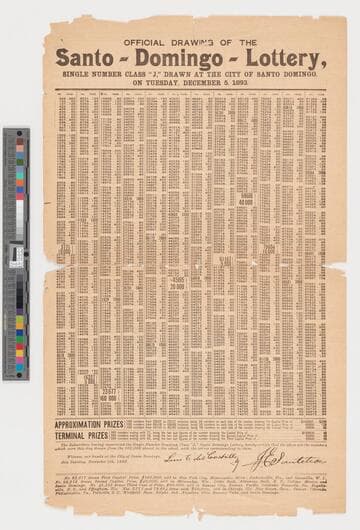
Official drawing of the Santo Domingo lottery…Tuesday, December 5, 1893
Visual Materials
Image of a leaflet, originally folded, advertising tickets by the Santo Domingo Guaranty Company for the Santo Domingo Lottery drawn on December 5th, 1893, in Santo Domingo, Dominican Republic. Recto includes a chart listing the number of gifts and amount of money awarded in the drawing. Verso is two folded pages, printed in blue, the left page includes information about the organizers of the event and the banks funding the drawing. Also included is information about winnings from different locations throughout the world. The right page includes text about individuals from Santo Domingo who supervised the drawing: Hon. Luis T. del Costillo and Hon. J.E. Santelices. Both individuals’ names are also signed on recto of print, though the spellings differ, they are signed as “Luis T. del Castillo,” and “J.E. Santetices.” The right of verso is printed in a decorative border with a decorative title that reads, “S.D.L.”
priJLC_SPO_003581
Image not available
[Church at Santo Domingo?]
Visual Materials
This collection contains photographs of Elizabeth Compton Hegemann's travels through the Navajo Indian Reservation and the Grand Canyon from 1922 to 1934. It also documents Southwest Indian life and archaeological monuments during Hegemann's career based at the Shonto Trading Post. The most notable images depict Hegemann; United States National Park Service rangers; Fred Harvey Trading Company sites and employees; Navajo and Hopi Indians; trading posts; Charles F. Lummis; the Grand Canyon; various ruins of Indian pueblos; Hopi ceremonies; Navajo horse races; and natural rock formations scattered throughout Arizona
NM 25
Image not available
Santo Domingo Pueblo. (Postcards)
Visual Materials
This collection contains approximately 10,000 photographs, negatives and ephemera created or compiled by Grace Nicholson (1877-1948), a collector and dealer of Native American and Asian arts and crafts in Pasadena, California. The bulk of the collection dates from 1903 to the 1920s and includes photograph albums and individual photographs with views of Native Americans of the Northwest Coast, California, and the Southwest of North America; pictures documenting Nicholson's basket collecting trips primarily between 1902 and 1912; images of Nicholson's stores and residences in Pasadena, including the building of the "Grace Nicholson Treasure House of Oriental Art" in the mid-1920s; and personal photographs of Nicholson, her family, friends, and associates. Nicholson's personal snapshots and photograph albums provide a valuable resource for studying Native American communities, particularly in Northern California, in the early 20th century. Many of the photographs depict daily life and include images of homes, community events, dances and rituals, families and children, and portraits. Most of these photographs were taken by Grace Nicholson or her assistant, Mr. Carroll S. Hartman, and are often accompanied by Nicholson's handwritten identifications.
photCL 56
Image not available
Lima: A court, Convent of Santo Domingo [Peru]
Visual Materials
This disbound album is made up of two volumes, the first containing late 19th century photographs of sites throughout Mexico and parts of South America; most notable are Mexico City, Guanajuato, Zacatecas, Peru, Bolivia, and the Mesoamerican ruins of Mitla, Tiahuanacu, and Gran Chimu. Some of the photographs in volume one are cyanotypes made by C.F. Lummis. Views of some California missions are also included, with a focus on San Fernando Rey. The second volume of the album also holds late 19th century photographs of Anglican church buildings in England, featuring York Minster, Winchester Cathedral, and Ely Cathedral.
photCL 238
Image not available
Lima: A Corridor, Convent at Santo Domingo [Peru]
Visual Materials
This disbound album is made up of two volumes, the first containing late 19th century photographs of sites throughout Mexico and parts of South America; most notable are Mexico City, Guanajuato, Zacatecas, Peru, Bolivia, and the Mesoamerican ruins of Mitla, Tiahuanacu, and Gran Chimu. Some of the photographs in volume one are cyanotypes made by C.F. Lummis. Views of some California missions are also included, with a focus on San Fernando Rey. The second volume of the album also holds late 19th century photographs of Anglican church buildings in England, featuring York Minster, Winchester Cathedral, and Ely Cathedral.
photCL 238
Image not available
Proyecto Santo Domingo: Memoria de la Primera Etapa
Manuscripts
The Leticia Quezada papers is a collection of personal and professional correspondence, documents, ephemera, and photographs related to her career in education, politics, and Mexican culture.
mssQuezadapapers