Rare Books
Across the continent
Image not available
You might also be interested in
Image not available
W. R. Densmore photograph album of early automobile touring
Visual Materials
An early automobile photograph album and scrapbook compiled by W. R. Densmore of the Packard Motor Car Company, Detroit. The album contains over 100 professionally-made photographs, with 19 approximately 8 x 10 inches, and also contains newspaper clippings about Densmore, early automobiles, and races. The album primarily chronicles Densmore's driving tours, although it also contains material dealing with other aspects of his life. Many images chronicle the famous Los Angeles to San Francisco drive of 1904, with Densmore and three companions seen in a Packard touring car. The other men were: H. B. Larzelere of Pacific Motor Car Company, San Francisco; Wallace W. Everett, guide; and H. A. French, correspondent for The Automobile magazine. Other images record similar overland auto journeys, in the White Mountains (1905); Long Island, New York (1905); the Wilkes-Barre Mountains, Pennsylvania (1905); and a grand tour of Italy (1913). Most of the automobiles featured are early Packard models, with riders in open-air cars, often wearing goggles and duster coats.
photCL 231
Image not available
W. R. Densmore photograph album of early automobile touring
Visual Materials
An early automobile photograph album and scrapbook compiled by W. R. Densmore of the Packard Motor Car Company, Detroit. The album contains over 100 professionally-made photographs, with 19 approximately 8 x 10 inches, and also contains newspaper clippings about Densmore, early automobiles, and races. The album primarily chronicles Densmore's driving tours, although it also contains material dealing with other aspects of his life. Many images chronicle the famous Los Angeles to San Francisco drive of 1904, with Densmore and three companions seen in a Packard touring car. The other men were: H. B. Larzelere of Pacific Motor Car Company, San Francisco; Wallace W. Everett, guide; and H. A. French, correspondent for The Automobile magazine. Other images record similar overland auto journeys, in the White Mountains (1905); Long Island, New York (1905); the Wilkes-Barre Mountains, Pennsylvania (1905); and a grand tour of Italy (1913). Most of the automobiles featured are early Packard models, with riders in open-air cars, often wearing goggles and duster coats.
photCL 231
Image not available
Photograph album of Barbara Hartman's automobile travels across the United States
Visual Materials
A travel album of approximately 500 snapshots and a few lithographic cards and commercially-produced photographs, compiled by a young woman named Barbara Hartman who lived in Seattle and possibly the Los Angeles area. The photographs are annotated with neatly-written captions that contain identifications and recollections of multiple automobile trips across the American West, to the East Coast and to the South in the years 1946-1949. The album documents ski trips to Snoqualmie Pass, Washington; nature and wildlife in Oregon and Wyoming; excursions to Glacier National Park and a stay at Many Glacier Hotel; the French Quarter, New Orleans; Miami and the Florida Keys; the Mammoth Caves, Kentucky; Washington D.C.; Mount Vernon; Philadelphia; New York City; Chiricahua National Monument and the town of Hayden, Arizona; the redwoods of Northern California; several popular tourist destinations in Southern California (including a visit to the Huntington Library); and repeat visits to a mountain cabin in Lake Arrowhead, California. A couple of different young women, identified only by first names, and sometimes her parents and others are pictured on trips with Barbara, who presumably took most of the photographs. There are scenes of large family gatherings and some trips to relatives' houses in different parts of the country. Photographs at the beginning of the album show Barbara and other young women outside a house in Seattle with their cats; she is also pictured ice skating with friends in Chicago and on jaunts with other women to New York City and Boston. Other scenes of note include a tour of antebellum plantation homes in Natchez, Mississippi; the Date Festival in Indio, California; and two women posing in a tourist "Tijuana jail" photo booth. This album provides a rich visual representation of automobile touring in postwar America and the experiences of women travelers.
photCL 612
Image not available
Myrtle Albright travel diary and scrapbook
Manuscripts
Scrapbook compiled by Myrtle Albright while on her transcontinental railroad trip in the summer of 1920 with her sister Julia. Their journey crossed the central Great Plains, the Southwest, with a visit to a Native American school in New Mexico, and Southern California before continuing to the San Francisco Bay area, Salt Lake City, Yellowstone, Chicago, and back to Durham. The scrapbook contains souvenir postcards and clippings, buttons for "Elliott Tours," excursion tickets and pieces of travel ephemera, and photographs. A detailed account, most likely written by Albright, describes locations visited, the sights seen, and their experiences both on the train and at various destinations. Accompanying the scrapbook is a separate 21 page hand-written account of a 1925 motor tour that describes touring in the vicinity of Washington, D.C. and Richmond, Virginia, and describes historic monuments and the weather.
mssHM 84084
Image not available
Travel Diary of Sir William Robert Clayton recounting his trip to America
Manuscripts
Sir William Clayton's journal details his 1871-1872 tour of the United States and parts of Central America. After crossing the Atlantic aboard the steamship Abyssinia, Clayton and his travelling companion arrive in New York at the end of October 1871. A brief stay in New York is followed by a train journey to Niagara Falls and thence to Chicago by way of Buffalo and Pittsburgh. After a brief description of the fire ravaged city, the journey continues on to Omaha. From Omaha, the train journey continues to Salt Lake City, where the travelers stay at the Townsend House. Several pages are devoted to Salt Lake, including a description of services at the Tabernacle. Next, Clayton departs via Pullman car to San Francisco, where he and his companion arrive in November 1871. Their stay in San Francisco includes visits to Cliff House, "China Town" and other sites, plus a trip to the New Almaden quicksilver mines near San Jose. Clayton leaves California by ship to return to New York via Panama. In addition to an account of Panama, Clayton describes visits to Jamaica, Mazatlan, Guatemala, Louisville, and New Orleans. Clayton returns to England in March of 1872. Clayton is an avid observer of "Americans" and throughout the journey describes, in great detail, his encounters with said individuals.
mssHM 70258
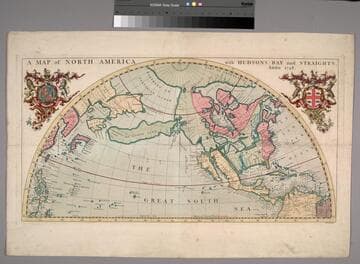
A Map of North America with Hudson's Bay and Straits, Anno 1748
Visual Materials
Kashnor notes, "THE ONLY COPY KNOWN, and privately issued by the Hudson's Bay Company. The main cause of this issue was the controversy concerning the alleged neglect of the Company to further the exploration for a North-West Passage. Arthur Dobbs was the leader of this opposition, and he hoped by proving the neglect, to see the company loose its privileges under the charter. Middleton, formerly a servant of the Company, had been sent to find the Passage, but had returned beaten, with the firm conviction that even if the passage did exist, it was impractical. This was in 1741-42. Dobbs, still unshaken, formed a company, which, with the thought of rights of exclusive trade, sent out the Dobbs Galley and the California in 1746. In October 1747, the two vessels returned to the Thames, the expedition a failure. In the following year the opposition to the company resulted in the Parliamentary Inquiry into the rights and working of the Company's charter. This map was part of the Company's case. There is no doubt that Seale, the engraver, executed the work according to the idea of the Company's officers, rather than following the true lines of geographical knowledge, which was available even in Middleton's map. Either the Company was very ignorant, or ready to connive at producing a fraudulent map. Around the Bay there is no outlet of any kind, and Sir Thomas Lancaster's Sound is located on the western side of the continent. The obvious intention of the map was to prove that the Passage went by way of the St. Lawrence, through the Great Lakes to Machilmakinac, where a junction was formed with the Long River of La Hontan, which gained by a portage across an isthmus, another portage from Tahnglak of La Hontan reached the Western Sea. In the Pacific the northern land seen by Vasco de Gama is shown touching the North-West coast, and there is shown De Fonte's track going in the direction of Alaska. It is a brilliant piece of geographical imagination, and yet the coastlines and locations of the Bay are correct. It seems likely that the map, as evidence, was too circumstantial, but it is in keeping with the whole of the inquiry of 1748-49, when the main object was to steer clear of questions regarding the charter, and it is possible that evidence of Joseph la France upset the evidence, and, naturally, the best way was to destroy all copies of the map. In any case, there is no other copy known to be in existence. It is, without doubt, the rarest of engraved maps of America, and unique." Kashnor is incorrect regarding the uniqueness of this map. The archives of the Hudson’s Bay Company at Beaver House, London, possess nine copies; there is another at the company’s Winnipeg headquarters. There is also a copy in the British Museum, presented by the company in 1957. See "The Beaver", Winter 1962, (Huntington F1060.1A1B4) for a full article about this map by Glyndwr Williams. Coat or arms of Hudson's Bay Company and Royal Arms of England.. Prime meridian: London. Relief: no. Projection: Azimuthal. Printing Process: Copper engraving. Other Features: Art Work. Verso Text: MS note: 443.
105:443