Rare Books
Anleitung zur Linearperspective
Image not available
You might also be interested in
Image not available
George Hannum notebook
Manuscripts
The manuscript is titled: A Compendious System of Practical Surveying taken from the latest Author by George Hannum, Philomath, and Taught by John Day, Preceptor. This fragile volume consists of approximately 54 pages of written text and diagrams. This is an advance work of surveying showing how to undertake the solution of complex problems. The manuscript opens with geometrical problems and moves on to right angle and oblique trigonometry. The text then shifts to finding areas of various shapes using logarithms. Also recorded are various methods of mapping and how to draw maps, ad methods of completing surveys for the division of land. It is in this section that Hannum applies colors to the illustrations of some of the surveys. There are two complete surveys and they are segregated in the text by being placed, inverted, on the last blank pages of the manuscript. From Birmingham Township, Pennsylvania.
mssHM 83602
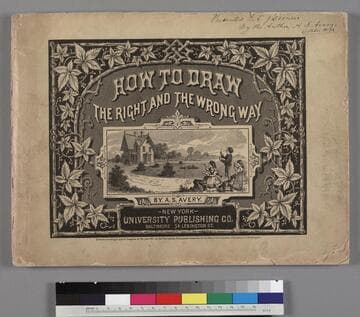
How to Draw: The Right and The Wrong Way
Visual Materials
One art instruction book entitled How to Draw: The Right and The Wrong Way, by A.S. Avery, published by The University Publishing Co., New York and Baltimore, copyright 1872. Also on the title page: "Illustrated with over one hundred figures. Adapted for use in public and private schools, and prepared expressly for all persons who do not know how to draw, but would like to learn." This book is comprised of 14 individual lessons, each of which consists of an illustrated (lithograph) plate and a numbered half-page of textual guidelines and instruction. The lessons are progressive in that each one builds upon the previous lesson, and they range from basic and introductory to more complex. For example, Lesson 1 is devoted to drawing straight lines; Lesson 4 is for shading "to give more boldness to the figures..."; Lesson 7 is a continuation of learning curved lines, and Lesson 14 is to draw a scene in which an old castle is the focal point. The front cover is elaborately decorated and illustrated; the title and cover vignette are framed by a stick-and-ivy pattern. The vignette pictures three children who are studying and drawing a house. The vignette is signed "Bobbett". On the back cover is a publisher's advertisement for "The Original Duntonian System of Rapid Writing", with a sample page from "Dunton's Drill Exercises in Movement". The insides of the front and back covers are blank. On the verso of the title page is a two-column list of drawing terms and definitions. "Presented to E.J. Loomis by the Author, A.S. Avery. October 1874" is written in ms., in ink, on the upper right-hand corner of the front cover.
ephKAEE
Image not available
The fabric of the human body : an annotated translation of the 1543 and 1555 editions
Rare Books
This title recreates the masterpiece of science and art for the first time in a way that is understandable to 21st century readers who do not have any knowledge of Latin. The texts of both the 1543 and the 1555 editions have been translated with the utmost care by Northwestern University Professors Emeritus Daniel H. Garrison and Malcolm H. Hast, a task they completed in over 20 years of painstaking and dedicated work. Annotations give the reader keen insight into just how innovative 'De humani corporis fabrica' was, and high-resolution digital scans of the almost 300 woodcuts provide the images with a sharpness they never had before.
762001
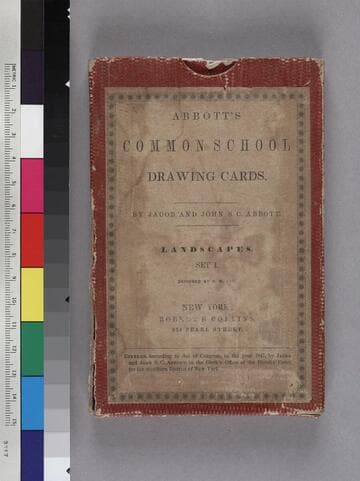
Abbott’s Common School Drawing Cards
Visual Materials
One set of drawing cards entitled Abbott’s Common School Drawing Cards, by Jacob and John S.C. Abbott, printed by Robert B. Collins, New York, 1874, Landscapes, Set 1, designed by B.H. Coe." On the back of the card box are instructions, entitled Arrangements, on the use of the cards. The cards are removed from the case by pulling on an insert. A notice "To the Teacher" on the verso of the insert explains how to teach drawing in school, and below this, "Reasons for Introducing Drawing into Common Schools" are listed. The card set is complete with the original forty cards, plus an extra card 1. They are numbered in Roman numerals, from No. I to No. XL, along with further drawing instructions on the back of each. For example, drawing card No. I shows a farm courtyard with various buildings and on the reverse the following instruction: "Whenever you have a pediment end of a building to draw, that is, an end terminated by a point at the top, where the two sides of the roof meet, as occurs in this lesson, always draw both the side walls first...."
ephKAEE
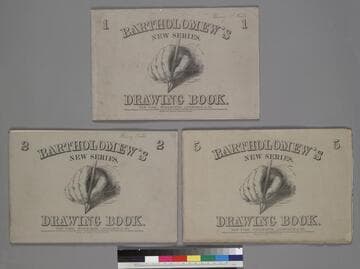
Bartholomew's Drawing Book, New Series, Nos. 1, 2, 5
Visual Materials
Three drawing books, entitled Bartholomew's Drawing Book, New Series, Nos. 1, 2 and 5, by William N. Bartholomew, published by Woolworth, Ainsworth & Co., New York, copyright 1867, 1869, and 1870 respectively. The exercises within each of the three books is comprised of 12 half-sheet numbered exercises interleaved with full-page blank leaves for copying and additional original artwork. Each book progress in level of difficulty, and the books themselves increase in their levels of complexity. Book 1 begins with exercises in drawing horizontal and vertical lines, and continues with using those lines in various combinations and patterns to draw simple designs and decorative forms. All of the exercises have been completed. On the inside front cover are notes and instructions for the series. Book 1 is missing the back cover; instructions for lessons 4 and later are missing. Book 2 incorporates angled straight lines, introduces curved lines, and begins to explore leaf and plant forms. These exercises are considerably more complex than those found in Book 1. Some of the exercises have been completed; primarily those at the very beginning and the very end of the book. The inside front cover contains notes about materials, notes to the teacher, and instructions for lesson 1. The back cover is also lacking. The 12 numbered exercises in Book 5 are of plants and flowers. Some of the images include pansies, lily of the valley, and a rose. Most of the exercises have been copied, and there are additional original drawings, some dated by the artist. The inside of the front cover contains notes about the materials to be used for this book and general remarks. The inside of the back cover contains instructions for using and copying the 12 lessons within the book. The outside back cover is a publisher's advertisement for various items within the "Bartholomew's System of Drawing", including writing and drawing slates, drawing books, drawing cards and a teacher's guide. The paper wrapper added by (presumably) Alice Dodge contains pencil sketches and doodles. "Henry I.[?] Tubbs" is written in ms. on the front covers of Books 1 and 2 in the upper right-hand corner. "Alice Dodge, Sept. 28, 1871" is written in ms., in pencil, across the top cover of Book 5.
ephKAEE
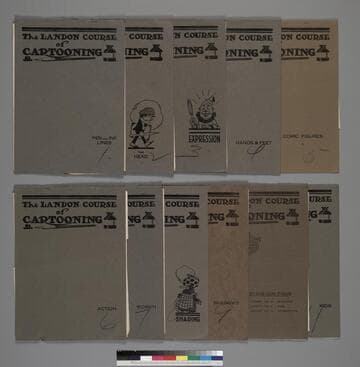
The Landon Course of Cartooning
Visual Materials
Eleven art instruction books entitled The Landon Course of Cartooning, published by The Landon School, Cleveland, Ohio, circa 1920-1930. This series is a correspondence course in drawing cartoons; each of the eleven separate lessons consists of circa 10 pages of textual instruction, with references to illustrated plates to use as guidelines. The lesson titles on each of the volumes are as follows (these booklets have been numbered, in ms., by a previous owner): Pen and Ink Lines (1); The Head (2); Expression (3); Hands & Feet (4); Comic Figures (5); Action (6); Women (7); Shading (8); Shadows (9); Division Four- Lesson No. 10 Shadows, Lesson No. 11 Kids, Lesson No. 12 Perspective (no number in ms.). Within the first booklet "Pen and Ink Lines" are general instructions, information about collecting a morgue, materials needed for pen and ink work, pen and ink lines Lesson No. 1, and instructions for mailing. The contents of each of the subsequent booklets are general guidelines and suggestions for the topic at hand, with references to sample images on separate plates. These are followed by guidelines for practice work, with specific instructions and assignments for the student to draw and submit by mail for evaluation. On the final page each booklet are mailing instructions. Some of the assignments within the entire series are: "Draw a two-thirds view of a thin-faced college professor scowling, to express SEVERITY. Put glasses on his nose" (from Expression); "Use Fig. D of Group 1 on Plate 3 as a guide and draw a sailor dancing a jig" (from Action); "Draw a fat cook with an apron tied around her waist, ready to bang someone with a shovel" (from Women); and "Make a group of three boys, sideview, playing with a cart. One boy is pulling, another is sitting in the cart, and the third is pushing behind. Get lots of action in this drawing" (from Kids). Nearly half of the individual booklets have their accompanying sample plates of illustrations laid in. The illustrations and comments within this series are very telling of the time in which they were issued: racist and derogatory illustrations and opinions abound. These booklets are vertically oriented, with the spine along the top. Pages are to be lifted from the bottom to the top; not from right to left as usual. The title for the series is at the top of each cover, and a single image is positioned above the booklet title in the lower right-hand corner. Some of the booklets have the title but no additional illustration on the cover. Most of the booklets contain original artwork (the exercises given in each booklet) by Mabel Spofford, with comments and additions from a Landon School instructor. Envelope 13, "Division Four"; Lessons 10-12, also contains an envelope from The Landon School, addressed to Mabel Spofford and postmarked March 5, 1928, which contains 2 sheets of Miss Spofford's original artwork, with comments from a Landon instructor. "1925 Edition" is printed on the front cover of the eleventh booklet "Kids".
ephKAEE