Manuscripts
Correspondence Relating to the Poets' Tribute to Thomas Hardy
Image not available
You might also be interested in
Image not available
Amos E. Hardy correspondence
Manuscripts
Letters that Hardy wrote to his parents during his Civil War service constitute the bulk of the collection. The letters describe the work on the defenses of Washington, D.C., including Forts Massachusetts (Stevens), DeRussey, Talbot, Ripley, Alexander, Franklin and Sumner; life in camp, particularly the food, healthcare, and various sports and amusements; the men of his regiment, including the hated regimental surgeon suspected of killing off "weak soldiers" and an "old Hypocrite" of a chaplain' encounters with fugitive slaves, slaveholders, Confederate prisoners, Union conscripts, etc. Hardy also discusses the affairs at home, (including the fate of his dog), and renders his opinion on war news and state and national politics, e.g. the draft and the Copperheads. Longing for a battle, he also shared various schemes that would allow him to be transferred to cavalry or the Navy. The letters also contain accounts of the beginning of Grant's Overland campaign and the battle of Poplar Springs where he lost his arm as well as descriptions of the Columbian Hospital in Washington, D.C. and the Beverly Hospital in New Jersey. The letter of Dec. 25, 1858 describes Christmas in Georgetown, Guyana and briefly recounts Hardy's impression of the West Indies. Also included are: Hardy's letter to his future employer, Mrs. Ames, written from Soldiers' Home in Bangor and detailing his Civil War service; his letters from Tillsonburg, Ont., discussing the town and Hardy's plans for the future; a letter from his son, Robert Samuel Hardy, with a detailed account of festivities in his Bangor, Me. school; a newspaper clipping with Amos E. Hardy's obituary, and an undated letter from G. Low to William Low of Castleton, Vt.
mssHM 81771-81832
Image not available
Thomas Nowell sermon, correspondence, and related material
Manuscripts
Correspondence and manuscripts regarding the controversy over Thomas Nowell's 1772 Charles I remembrance sermon before the House of Commons, bound together with the printed sermon. Letters to Nowell are from W. (presumably Walter) King and Dr. (presumably James) King, the sermon's printer Henry Hughs, Lord Lichfield, Thomas Fitzmaurice, the Rev. Richard Scrope, and others; letters are both in support of and in opposition to Nowell's sermon. In addition, there are two copies of Thomas Nowell letters to unidentified recipients. Also present in the volume are a manuscript vote of thanks for Nowell's sermon from the House of Commons with an order to print, January 31, 1772; and manuscript extracts from a letter of Edward Gibbon and from the Annual Register regarding the sermon. The front of the volume contains a manuscript table of contents and provenance note, the bulk of which was most likely written in the late 19th century with a note added after 1916 at the end.
mssHM 84141
Image not available
Thomas Nowell sermon, correspondence, and related material
Manuscripts
Correspondence and manuscripts regarding the controversy over Thomas Nowell's 1772 Charles I remembrance sermon before the House of Commons, bound together with the printed sermon. Letters to Nowell are from W. (presumably Walter) King and Dr. (presumably James) King, the sermon's printer Henry Hughs, Lord Lichfield, Thomas Fitzmaurice, the Rev. Richard Scrope, and others; letters are both in support of and in opposition to Nowell's sermon. In addition, there are two copies of Thomas Nowell letters to unidentified recipients. Also present in the volume are a manuscript vote of thanks for Nowell's sermon from the House of Commons with an order to print, January 31, 1772; and manuscript extracts from a letter of Edward Gibbon and from the Annual Register regarding the sermon. The front of the volume contains a manuscript table of contents and provenance note, the bulk of which was most likely written in the late 19th century with a note added after 1916 at the end.
mssHM 84141
Image not available
Sidney W. Hardy journal
Manuscripts
This volume chronicles Hardy's voyage from New York City around Cape Horn to San Francisco. He includes details regarding the conditions on the ship and problems among the crew leading to the dismissal of the second mate while the ship was at port at Valparáiso, Chile. The journal also covers Hardy's attempt at mining as well as his experience in owning a store that sold supplies to miners. Hardy makes a specific reference to some Indians who came to his store regularly to trade gold for supplies; these Indians were probably the Yokuts who mined for gold along the Stanislaus River.
mssHM 62959
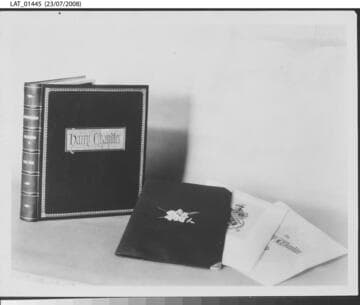
Harry Chandler tribute book and three related items
Manuscripts
Black and white photograph of tribute book and three related items presented to Harry Chandler by the Times employees on the occasion of the 50th anniversary of the newspaper, including a leather(ette) folder which contained the coat of arms and the dedication page. May Goodan Collection.
mssLAT 01445
Image not available
Grahame Hardy Collection
Manuscripts
The collection was assembled by author and collector Grahame H. Hardy, the chronologically-arranged collection is divided into three series: documents and manuscripts; correspondence; and ephemera. The documents and manuscripts demonstrate the range of legal, administrative, municipal, and real estate-related transactions initiated by railroad and mining interests, businessmen, and municipalities in the San Francisco Bay area, Northern California, and western Nevada. Included in this series are legal proceedings, title deeds, mining reports and claims. Correspondence includes business and personal letters to and from Northern California lawyers, railroad and mining entrepreneurs in California and Nevada, and parties involved in the construction of the Nicaragua Canal. Included in this series are letters pertaining to the case of Daniel Sill, a San Francisco-based blacksmith and the trial of A.J. Jackson, an African American tried and acquitted in Marysville, California. Lastly, ephemera include four items: a Mission Homestead Association certificate of stock; one check payable to Jack H. Haverly, a promoter of minstrel shows, from theater producers and brothers, Gustave Frohman and Charles Frohman; the baptism certificate of Everett Loftus Saxondale Kenna; and an undated glossary of mining terms. Prominent persons and organizations featured in the collection include: California Academy of Sciences, founded in 1853 as the one of the first scientific academies west of the Atlantic seaboard. Central Pacific Railroad Company, established in 1861 and financed in part by Leland Stanford and Collis P. Huntington, who are also mentioned in the collection. William Heath Davis (1822-1909), San Francisco merchant and author, spouse of Maria de Jesús Estudillo, who played a key role in the founding of the California cities of Oakland and San Diego. John Brooks Felton (1827-1877), San Francisco Bay Area lawyer and judge, as well as one-time mayor of Oakland, California. Joseph Pendleton Hoge (1810-1891), former U.S. Representative of Illinois and later lawyer and judge of the San Francisco Superior Court. M.G. Upton, former official reporter of the California Assembly and author of the urban planning critique, "The Plan of San Francisco" (1869).
mssHM 72670-72753