Visual Materials
Navajo hogans

You might also be interested in
Image not available
Navajo hogans
Visual Materials
This collection contains approximately 10,000 photographs, negatives and ephemera created or compiled by Grace Nicholson (1877-1948), a collector and dealer of Native American and Asian arts and crafts in Pasadena, California. The bulk of the collection dates from 1903 to the 1920s and includes photograph albums and individual photographs with views of Native Americans of the Northwest Coast, California, and the Southwest of North America; pictures documenting Nicholson's basket collecting trips primarily between 1902 and 1912; images of Nicholson's stores and residences in Pasadena, including the building of the "Grace Nicholson Treasure House of Oriental Art" in the mid-1920s; and personal photographs of Nicholson, her family, friends, and associates. Nicholson's personal snapshots and photograph albums provide a valuable resource for studying Native American communities, particularly in Northern California, in the early 20th century. Many of the photographs depict daily life and include images of homes, community events, dances and rituals, families and children, and portraits. Most of these photographs were taken by Grace Nicholson or her assistant, Mr. Carroll S. Hartman, and are often accompanied by Nicholson's handwritten identifications.
photCL 56
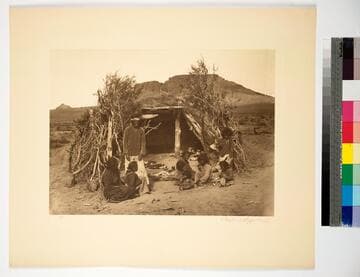
A Navajo home (Hogan) on the Chinle desert
Visual Materials
Navajo Indian family in front of their summer shelter, or hogan.
photCL 312
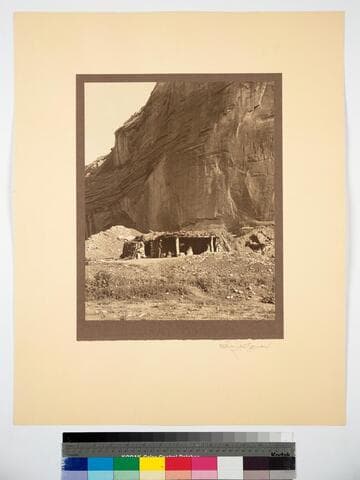
Navajo Hogan in Canyon de Chelly
Visual Materials
Navajo hogan with a family inside and a donkey to the right.
photCL 312
Image not available
Navajo Mountain
Visual Materials
Volume containing typescript account and approximately 67 snapshots of trip to the American Southwest begun on August 14, 1931, by Baker and Huck, illustrated with pasted clippings, published illustrations and postcards. The photographs and the descriptions document camping, the natural landscape, rock formations, tour guide Jack Wilson and his wife, Katherine Wilson, travel by automobile and burrows, Navajo trading posts, and cliff dwellings. Included are two images and a description of a Navajo "sheep dip," identified as "Navajos dipping sheep and goats in a lime-sulphur solution for 'scabs.' Near Tonalea." Locations include Arizona; Utah; Rainbow Bridge; Surprise Valley; Navajo Mountain; Santa Fe, New Mexico; Puyé cliff dwellings; and the Taos Pueblo. With "Harveycar Motor Cruises through the Great Southwest" map pasted in at back of volume. Binding stamped "Grabau."
photCL 237
Image not available
Navajo sheep herding and dipping; hogan exteriors
Visual Materials
A collection of photographs and postcards focusing on Navajo and Hopi Indians and various Indian schools and schoolchildren throughout Arizona, mostly in ca. 1927. There are views of Peach Springs Trading Post, the Cameron Suspension Bridge trading post, missions at Chinle and Lukachukai (Arizona), Navajo family groups, Navajo schools at Tuba City and Oraibi (Arizona), and Navajo school crafts fairs and exhibits. Acoma, Apache, Tohono O'Odham (Papago), and Hualapai Indians are also represented. The photographs were taken from 1890 to 1927, but the bulk of the collection was created during the 1920s. Includes some photographs by George Wharton James, E.E. Hall, and Burton Frasher (Frasher Fotos). These images of Indians were taken as both posed and candid field photographs, in particular of young Navajo schoolchildren during class time and outside of school. Other subjects pictured are L.H. McSparron, owner of Thunderbird Ranch and acting custodian of Canyon de Chelly; Father Leopold Ostermann, the founder of the mission at Chinle; possibly John Lorenzo Hubbell Jr., of the Hubbell trading family; an Indian all-boys track-and-field team at an unidentified school; Indian schoolchildren; and nature views throughout Arizona. The photographs have been arranged by Indian tribe, starting with the tribe with the most photographs and/or postcards. Navajo Indians appear first in the arrangement, followed by Hopi, Apache, and other Southwestern tribes with fewer photographs. Within each tribe, photographs and postcards have been further organized by individual tribe members, activities, crafts, associated communities, and schools. Images of Caucasian people involved in Indian trade, trading posts, and unidentified Indian schools and students are placed at the end of this collection. Russell also collected postcards with images of Southwest Indians, with some cards having correspondence from Russell, addressed to Beatrice Madelleine, Mrs. George R. Simmons, and Madeleine Touchaux (Russell's wife), describing how travel conditions were as well as opinions on the Indians that were encountered.
photCL 399
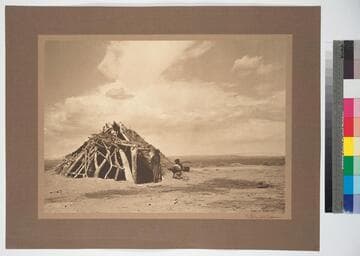
Navajo hogan on the edge of the Chinle desert in Northeastern Arizona
Visual Materials
View of a Navajo dwelling in the Chinle desert, a woman and child sitting and standing outside of it.
photCL 312