Manuscripts
Book of John Mandeville : [manuscript]

You might also be interested in
![Book of Hours, Sarum use : [manuscript]](/_next/image?url=https%3A%2F%2Frail.huntington.org%2FIIIF3%2FImage%2F22APN4KTX7LC%2Ffull%2F%5E360%2C%2F0%2Fdefault.jpg&w=750&q=75)
Book of Hours, Sarum use : [manuscript]
Manuscripts
ff. 1-187v. [Book of Hours]: ff. 1-6v: Calendar; ff. 7-84v: Hours of the Virgin, Sarum use, missing the illuminated opening leaves before ff. 7, 22, 55, 65, 69 and 77, with suffrages after lauds of the Holy Spirit, the Trinity, the Cross, Michael, John the Baptist, Peter and Paul, John the Evangelist, Edmund king and martyr, Lawrence, Stephen, Nicholas, Mary Magdalene, Catherine of Alexandria, Margaret, All Saints, and for peace; ff. 85-118v: Penitential psalms, gradual psalms and litany; ff. 119-184v: Office of the Dead, Sarum use (one leaf missing before f. 131 with loss of text); ff. 185-186: [added, 14th/15th c.] St. Gregory's Trental; f. 186v: [added, 14th/15th c., in a different hand from above]: Advowsons of 35 churches mainly in Somersetshire and in Devonshire; f. 187: [added, early 14th c.] Prophecy of the Lily, the Lion and the Son of Man; f. 187v: [added, early 14th c., in the same hand as the prophecy]: Reasons for the deposition of anti-Pope John XXIII.
mssHM 1346
![Book of Hours, use of Rome : [manuscript]](/_next/image?url=https%3A%2F%2Frail.huntington.org%2FIIIF3%2FImage%2F22APN4KGF8KE%2Ffull%2F%5E360%2C%2F0%2Fdefault.jpg&w=750&q=75)
Book of Hours, use of Rome : [manuscript]
Manuscripts
ff. 1-180; [Book of Hours]: ff. 1-12v: Calendar in red and black; ff. 13-21v: [f. 13, blank], Short hours of the Cross; ff. 22-29: [f. 22, blank], Short hours of the Holy Spirit; f. 29v, ruled, but blank; ff. 30-37v: [f. 30, blank], Mass of the Virgin; ff. 38-44: Pericopes of the Gospels; f. 44v, ruled, but blank; ff. 45-106v: [f. 45, blank], Incipiunt hore beate marie virginis secundum usum romanum; ff. 107-126v: [f. 107, blank], Penitential psalms and litany; ff. 127-162: [f. 127, blank], Office of the Dead, with 3 lessons; ff. 162-180: Obsecro te and O intemerata, and suffrages of Michael, Peter and Paul, John the Baptist, Sebastian, Nicholas, Anthony abbot, Mary Magdalene, Catherine of Alexandria, Barbara, Agnes, Genevieve. [f. 180v, blank].
mssHM 1136
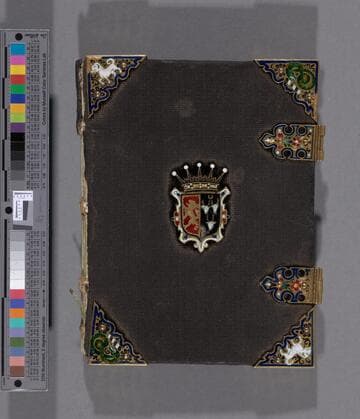
Crypto-Catholic Shrewsbury prayer book : manuscript
Manuscripts
1. f. 1r-v. Morning prayer. Lighten myne eyes o Lorde, least at any tyme I oversleepe in sinne, and least myne enemy doe say I have prevailed against him ... 2. ff. 1v-2r. Evening prayer. Allmighty and everlasting God, I render thee most heart thanckes, for that thou has vouchsafed of thy great mercy and goodnes, to preserve mee this day from all evill ... 3. ff. 2r-3v. A prayer to stirre up the minde to devotion in prayer. Allmighty and most mercifull Father, unto thee all the heavenly company of the Celestiall cytie, all the blessed orders of saved spirits do wth due reverence sing continuall glorie and everlasting praise ... 4. ff. 3v-10r. A confession of my sinnes & weaknesses wth petitions for the pardoning of the one, & strengthening of ye other. Have mercie vpon mee and spare mee good Lorde, and suffer mee not to perish in my sinne ... 5. ff. 10r-18r. Another confession wth such like petitions. Graunt me most mercifull God, fervently to desire such thinges, as may bee acceptable and pleasing unto thee, wth wisedome to serch after those, not to bee deceived in the knowledge of those, and unfainedly to accomplish the doing of those ... 6. f. 18r. A prayer desiering God to order & direct mee. Lorde God thou knowest what thing is to mee most profitable to doe, this or that, after thy will: ... 7. ff. 18v-19r. A thankesgiving for my beeing. O God thou mightest have kept mee from being at all, and (being) thou maist make mee, as if I never had been, but seeing of they wonderfull goodnes, also doost suffer mee still to bee: ... 8. ff. 19r-20r. Before the receiving of the holy Sacrament. O Benigne Jesu that wouldest suffer so many grevous paynes, yea death itself for love of mankinde, great and marveilous is they charity, give mee grace to receive, thy precious body in forme of bread this day, with purity of heart and cleanes of soule, with love, dread, and stedfast beleef. ... 9. ff. 20v-21r. After receiving the holy Sacrament. Thankes bee unto thee o holy Father God Almyghty, that thou didst vouchsaufe of thy great pity, to send thy only sonne from thy high throne into this vale of woe & miserye, ... 10. ff. 21r-22v. A prayer or thanckesgiving unto ye Holy Trinity. O Blessed Lorde God, Father, Sonne and Holy Ghost, three personnes and one God, my Lorde, my God, my maker, my redeemer, my norisher, my defender, my sweetnes, my mercy, my refuge, my strength, my victory, my joy, and my glory eternall; I laud thee, I glorifie thee, I honor thee. ... 11. ff. 22v-24v. Prayers in Sicknesse. O Sweete Jesu, I desire nor life, nor death, but they most holy will. Thee O Lorde I looke for, bee it unto mee according to thy pleasure. If thou wilt sweete Jesus that I dye, receive my soule ... 12. ff. 24v-25r. A prayer for a sick body ready to die. Have mercy and spare him o Lorde; deliver him from thine anger, from an evill death, from the danger of death; from the paines of hell, from all evill, from the power of the Devill. ... 13. ff. 25r-26r. Christ deliver thee from all torment, who was crucified for thee. Christ deliver thee from death, who hath vouchsafed to dye for thee; Christ the sonne of the living god, place thee in the garden of his paradise, which alwaies is pleasant and flourishing ...
mssHM 83695
![Album of English manuscripts : poems, epigrams and letters written between 1450 and 1790 : [manuscript]](/_next/image?url=https%3A%2F%2Frail.huntington.org%2FIIIF3%2FImage%2F22APN4ON0P40%2Ffull%2F%5E360%2C%2F0%2Fdefault.jpg&w=750&q=75)
Album of English manuscripts : poems, epigrams and letters written between 1450 and 1790 : [manuscript]
Manuscripts
1. ff. 1-2. Prophecy of the Tiburtine Sibyl. Incipit: //autem illum honorant eternam vitam hereditabunt perpetuum cuius ipsi hereditabunt paradisum sicut amenissimum ortum. Mortuorum vero resurrectio erit. Explicit: Et ipsi regnabunt cum eo in secula seculorum amen. Latin. Prophecy of the Tiburtine Sibyl, see E. Sackur, Sibyllinische Texte und Forschungen (Halle 1898), here beginning defectively and corresponding to Sackur's edition only on pp. 180-87, from the interpretation of the 5th Sun on; what remains here of the 4th Sun (most of the first column) is expanded with respect to Sackur. For the verses, see Walther, Initia 9907. 2. f. 2r-v. [Pseudo Anselm] De conceptione beate Marie. Incipit: Anselmus cantuariensis archiepiscopus et pastor anglorum coepiscopis suis salutem et benedictionem. Conceptio veneranda sancte dei genitricis Marie fratres dilectissimi quemadmodum multa signorum experimenta in anglia et in francia ceterisque cosmi climatibus olim sit declarata me narrante audiat dilectio vestra. Helsino ramensis ecclesie abbate. Explicit: utramque sacratissimam eius conceptionem spiritualem videlicet et humanam ut ipsius suffragio a terrenis contagiis exuti conceptioni in sinu abrahe mereamur ascribi Annuente filio virginis unico domino nostro ihesu christo cui cum patre et spiritu sancto est honor et gloria in secula seculorum amen. Latin. Abbreviation of the sermon, Ps. Anselm,"De conceptione beate Marie"; PL 159:319-324. Added in the in the lower margin in a contemporary hand, an excerpt from the same sermon (but not abbreviated): the miracle of the Virgin in saving Elsinus, abbot of Ramsey, so that he could honor the feast of the Immaculate Conception ("[T]empore illo quo divine placuit pietati anglorum gente de malis suis corrigere. . .et que viderat et audierat quibus potuit notificavit."); PL 159:319-320. 3. ff. 2v-3v. [Suidas] Lexicon. Incipit: Narratio ex libro qui grece vocatur Suda quem composuerunt viri sapientes isti Eudemus rethor, helladius qui tempore Theodosii iuvenis, Eugenius Frigius, Zosimus, Gazeus. Explicit: Sed vere ut familiari amico philippo apud iudeos absconditum secretum propalavit. Latin. Other creator(s): Robert Grosseteste, translator. Grosseteste's translation of the second article of Suidas' Lexicon on Ἰησοῦς or"De probacione virginitatis beate Marie"; see S. Harrison Thomson, The Writings of Robert Grosseteste, Bishop of Lincoln 1235-53 (Cambridge 1940) 64-65. 4. f. 3v. [Hichecoke?] This Worlde is but a Vanyte. Incipit: How schal a mann in pes abide/ Hy hert and enuy set aside. Explicit: Eche man wel beholde his degre/ For this worlde is but a vanyte. Quod hichecoke. English. IMEV 1261. R. H. Bowers,"Hichecoke's 'This Worlde is but a Vanyte'," MLN 67 (1952) 331-33 from this manuscript, taking the signature"quod hichecoke" to be that of the author; Hichecoke may also, or only, be the scribe. Some previous printed texts have mistakenly supplied the initial"W." for"quod." On f. 4, a modern leaf, 2 transcriptions of the poem, one imitating the fifteenth century script of f. 3v, the other in a modern hand by Joseph Haslewood; f. 4v, blank. Another transcription by Joseph Haslewood of this poem is London, Brit. Lib., Add. 11307, f. 120r-v. 5. f. 5. Incipit: As I walkyd vppon a day/ To take þe aere of feld and flowre. Explicit: And withyn his gloryus blysse thatt we all may dwell/ And geve vs there licence to lyve yn ese. English. IMEV 373. C. Brown, ed., Religious Lyrics of the XVth Century (Oxford 1939) 273-77 from this manuscript. A transcription by Joseph Haslewood of this poem is Add. 11307, f. 121. 6. f. 5v. [John Lydgate] Dietary. Incipit: For helth of body couer fro colde þine hede/ Ete no raw mete take good heede þer too. Explicit: And all sayntes reioisyng in þe trinyte/ Bryng vs to þat hy glorious towre Amen for charyte. Rubric: A dietorie. English. IMEV 824. John Lydgate, A Dietary, printed by J[oseph] H[aslewood] in Censura Literaria 7 (London 1808) 345-49 from the 1618 edition, from London, Brit. Lib., Harley 2251 and from this manuscript, noting the variants. On f. 6, a modern leaf, a transcription by Joseph Haslewood of the 1618 edition of this poem; f. 6v, blank. Another transcription by Joseph Haslewood of this poem is Add. 11307, ff. 124, 126. 7. 3 leaves mounted on ff. 7-9. [Francis Bryan, attributed] Proverbes of Salmon. Incipit: The proverbes of Salmon do playnly declare/ That wysdome ys the vessell that longest will endure. Explicit: When thowe spekest let men marvell at thy shamefacenes/ When thow spekest not let them wondre at thy sobernes. Withe leavinge honour to women I ende, quod Bryan. English. R. S. Kinsman,"The Proverbes of Salmon Do Playnly Declare': a Sententious Poem on Wisdom and Governance, Ascribed to Sir Francis Bryan," HLQ 42 (1978-79) 279-312;"Bryan" may also, or only, be the scribe. 8. 18 pages between ff. 9-10. The lay of Dame Sirith. Transcript of Saxon poem by J.J. Conybeare (1779-1824) from Digby manuscript 86. 9. Leaf mounted on f. 11. Incipit: Thou hidd & secret deitye I worshipp & adore/ I glorifye & honor thee devoutly more & more. Explicit: with face reveled cleare & bright yat I may blessed bee/ As yat sweet light so glorious all glory be to thee. Amen. Blessed Thomas Aquinas. Rubric: Confession & honor to the Blessed Sacrament. English. A verse translation of Thomas Aquinas, Adoro te devote latens deitas [RH 519]. On the verso of this leaf, upside down, accounts for stabling dated 1552; on the following leaf, f. 12, a modern transcription of the poem, possibly not in the hand of Joseph Haslewood. 10. 16 pages (2 blank) interleaved between ff. 13-14. A Nosegaie alwaies sweet for lovers to send for tokens of love at NewYeares tide. Appears to be a transcript made at the end of the eighteenth century of an unidentified fifteenth century source. Text is incomplete, final page ends with catchword"And". 11. Interleaved between ff. 15-16. 1 page. [Samuel Rowlands]. In condemnation of bald heads. Late eighteenth century copy. 4 pages. Arthur Saul. Game of Chess. A transcript of an unidentified pamphlet in rhyme, signed by Arthur Saul. 12. Mounted on f. 17. 3 poems including"To Rosania and Lucasia, articles of friendship" by Katherine Philips (1632-1664). 13. Interleaved beween ff. 21-22. 4 poems including: A new song on ye 25th of September. An original composition on the marriage of King James II. On the reverse is a satirical poem about the birth of the James Francis Edward Stuart, Prince of Wales (the Old Pretender) mentioning Bishops Thomas Sprat, and Nathaniel Crew. 14. 1 page mounted on f. 22v. A newe elegie on ye much lamented death of captaine Thomas Green who was executed with others of his crew under ye pretence of being a pyrate in Scotland, 11th April, 1705. 15. Mounted on f. 25. 1 page. On General Wolfe slain at the taking of Quebec on the 1t8h Sept., 1799. 1 page. On the King's illness, 1789. An epigram which references to America. Note reads:"Copied from an edition of Tom Paynes Common Sense belonging to Mr. Ritson and written on the back of the title-page in his handwriting."
mssHM 183
![Translation of Higden's Polychronicon, along with other translations of works into Middle English : [manuscript]](/_next/image?url=https%3A%2F%2Frail.huntington.org%2FIIIF3%2FImage%2F22APN4KP0RH5%2Ffull%2F%5E360%2C%2F0%2Fdefault.jpg&w=750&q=75)
Translation of Higden's Polychronicon, along with other translations of works into Middle English : [manuscript]
Manuscripts
ff. 1-5v: [Pseudo William Ockham, translation of Dialogus inter militem et clericum]: Rubric: Dialogus inter militem et clericum. Incipit: Clericus y wonder sir noble knyȝt þat in fewe daies tymes beþ chaungid riȝt is yburied lawes biþ ouertorned. Explicit: Also in þe tyme of gospel hit is writen þe holy day is made for man and nouȝt man for þe holy day. Explicit dialogus inter clericum et militem. ff. 5v-20v: [Richard FitzRalph, translation of Defensio curatorum]: Rubric: Incipit sermo domini archiepiscopi Armacani. Incipit: Demeþ nought by þe face but riȝtful dome ye deme. John 8o co. Holy fadir in þe bigynnyng of my sermoun I make a protestacioun. Explicit: þerfore I conclude & pray mekelich & deuoutlich as I prayed in þe first þat I touchid: demeþ nouȝt bi þe face et cetera. Explicit. ff. 21-23v: [Pseudo Methodius, translation of Beginning of the World and the End of Worlds]: Incipit: In þe name of crist here bigynneþ þe boke of methodii þe bisshop of þe chirche of paterenis and martir of martir of [sic] crist. Explicit: And wicked men wiþout ende shul suffre peyne. Wherefore þe lord vouche he saaf to delyuer vs. qui cum patre et cetera. Explicit liber metodii episcopi. ff. 24-40v: [Alphabetical subject indexes to the Polychronicon in Latin and then in English with reference to books and chapters]. ff. 41-42: [Dialogue between a Lord and a Clerk upon Translation]: Incipit: Siþþe þat babel was ybuld men spekiþ diuerse tonges. Explicit: þan alle þat ben ywrite in þe boke of lyf shal wynde wiþ him into þe blisse of heuen and be þere in body and soule and se & knowe his godhed and manhed in Ioy wiþout eny ende. Explicit dialogus. f. 42r-v. [John Trevisa, Epistle to Sir Thomas of Barkley]: Incipit: Welþe and worshipe to my worthy and worshipful lord sir Thomas lord of Berkley. I Iohan Treuysa youre prest and youre bedman. Explicit: to se god on his blisful face in ioy wipout eny ende. Amen. Explicit epistola. ff. 43-319v: [Ranulph Higden, translation of Polychronicon]: Prologue: Incipit prefacio prima, Aftir solempne and wise writers of art and of science þat had swetnesse & likyng al her liftyme ... Prologue [f. 44v]: Prefacio secunda ad historiam, And for þis cronicle conteyneþ beringes and dedes of meny tymes ... Prologue [f. 44v]: Prefacio tercia ad historiam, To hem þat wole haue ful knowelech of stories it nedeþ eiȝte þinges to knowe ... Rubric: De orbis dimensione priscianus in Cosmagraphia [sic]. Incipit: Iulius Cesar by Counsaile of þe senatours and elder men of Rome loked and serched stories ... Explicit: þis translacion is endide in a þursday þe xviii day of Aueril þe yere of oure lorde a þousande þre hundred foure score and seuen þe tenþe yere of king Richard þe second aftir þe conqueste of englande þe yere of my lordis age sir Thomas lorde of Berkeley þat made me make þis translacion fiue and þritty. Explicit. ff. 320-325v: [115 verses on the kings of England from Alfred to Henry VI; followed by several documents concerning Richard II (his renunciation of the throne), Henry IV, Henry V, Henry VI and Edward IV (his claim to the throne of France with 2 genealogical tables]: Rubric: Hic metrice tractatur de regulis ab aluredo primo fundatore universitatis Oxoniensis circiter Annum domini D CCC lxiii usque ad henricum sextum. Incipit: Aluredus rex anglorum primusque monarcha/ Belliger invictus in scripturis bene doctus ... Explicit: Hoc tunc in fine verborum queso meorum/ Prospera quod statuat regna futura deus. Amen. [f. 325v, ruled but blank]. ff. 326-337v: [Pseudo Turpin, translation of Historia Karoli Magni; ending defectively in the 26th of 36 chapters]: Prologue: Turpine the Archebisshop of þe Bataille of Rouncivale. Here begynneth þe prologe of Turpines Story, Tvrpyne by the grace of god Archebiship of Reynes a bisye ffoluere and of grete Emperoure Charlis a ffelow with leoprande Dene of Akim gretinge and helthe euerlastinge in god ... ; [Chapter list]: B[rubricator's error for H]ere beginneth the Titulus of þe Chapitres of the Storye of the Bataille of Rouncivale of grete Charles the Emperoure, Capitulum 1m, [H]ow seynt Iame aperid to Charlis; Capitulum ii, [H]ow þe wallis of pampilione fylle down by hem selffe ... Rubric: How seint Iame apered to king Charles, Capitulum 1. Incipit: After oure lord ihesu criste had sufferid deþe and paid þe Rawnsome for synfulle man. Explicit: þen Roulonde lete him goo, and he callid to god to helpe him. And anone//. The text is preceded by a prologue and a chapter list:
mssHM 28561
![Vox clamantis and other Latin poems : [manuscript]](/_next/image?url=https%3A%2F%2Frail.huntington.org%2FIIIF3%2FImage%2F22APN4KTZMJE%2Ffull%2F%5E360%2C%2F0%2Fdefault.jpg&w=750&q=75)
Vox clamantis and other Latin poems : [manuscript]
Manuscripts
ff. 4-183v. [John Gower] Vox clamantis. Incipit: Scripture veteris capiunt exempla futuri. Explicit: Que meruit fata sunt sibi fine data. Explicit libellus qui intitulatur Vox clamantis. Rubric: Incipit Cronica que Vox clamantis dicitur, In huius opusculi principio intendit compositor describere. English. G. C. Macaulay, ed., The Complete Works of John Gower (Oxford 1902)"Latin Works" 4:3-313; this manuscript described on pp. lxv-lxvi where it is said to be related to London, Brit. Lib., Cotton Tiberius A.iv in text and spelling; see also J. H. Fisher, John Gower, Moral Philosopher and Friend of Chaucer (New York 1964) 101-02, where HM 150 is placed in the C Version, and dated on the basis of textual evidence between ca. 1392 and 1399. The first leaves, ff. 1-3v, blank except for modern title and verses, s. XV, on f. 1:" Si decies quinque cum quinque velis numerare/ ysak adde caput caput et ter nominum [?] illud" (a political prophecy? See Ward, Cat. of Romances, 1:311). On ff. 4-13v are the chapter list, the quatrain ("Ad mundum mitto mea iacula dumque sagitto. . ."), and the picture of Gower shooting at the world; the text itself begins on f. 14. The bifolium, ff. 119-120, is bound in reverse order. ff. 184-188v. [John Gower] Carmen super multiplici Viciorum Pestilencia. Incipit: Quod patet ad limen instanti tempore crimen. Explicit: Pax manet absque dolo longaque vita datur. Explicit. Rubric: Contra demonis astuciam in causa lollardie. Latin. Macaulay, here skipping some verses with respect to the printed text: 346-48; 348-50; 352-54; 350-52. ff. 188v-190v. [John Gower] De lucis scrutinio. Incipit: Heu quia per crebras humus est viciata tenebras. Explicit: Lucis solamen det sibi christus Amen. Explicit tractatus de lucis scrutineo. Rubric: Incipit tractatus de lucis scrutinio quam a diu viciorum tenebre prothdolor suffocarunt. Latin. Macaulay, 355-57. ff. 190v-192v; ff. 193-194v blank. [John Gower] O deus immense. Incipit: Cultor in ecclesia qui deficiente sophia. Explicit: Aufert hoc nemo quod dabis ipse deo. Explicit. Rubric: Incipit carmen quod Iohannes Gower tempore regis Ricardi secundi dum vixit ultimo composuit, O Deus inmense sub quo dominantur in ense. Latin. Macaulay, here skipping some verses with respect to the printed text: 362-64; 368; 367; 368.
mssHM 150