Manuscripts
Shokubutsu Zu : [manuscript], [approximately 1800]

You might also be interested in
Image not available
Sokuryō mitsugaku : [manuscript]
Manuscripts
Book on trigonometry; begins with fundamental descriptions, illustrations and explanations of triangles i.e. right angles, areas, etc.; latter sections includes complex formulas, and their relation to land surveying; formulas written in both Japanese/Chinese characters and Roman alphabet/numerals. In Japanese.
mssHM 81205
Image not available
Nagasaki hyosho zu - Karafune hyosho zu
Manuscripts
These two volumes contain 70 single or double-page gouache plates and record the life of Dutch and Chinese merchants in Nagasaki, Japan, in the early 19th century. The first volume focuses on the Dutch living in Dejima and includes historical events such as the visit of Russian envoy Nikolai Rezanov, cultural practices such as the fumie ritual which the Japanese used to detect Japanese Christians, and the infrastructure surrounding the port. The volume also documents Dutch daily life such as medical procedures, clothing, meals, and phonetic renderings of the Dutch alphabet and numbers. Illustrations of Javanese and Southeast Asian servants and laborers are also depicted throughout the first volume. The second volume focuses on the Chinese merchants and documents their ships, warehouses, residential compounds, tools, theatrical culture, religious objects, and burial sites. There is a detailed three-page illustration of the Tojin-yashiki, the walled enclosure where the Chinese merchants lived. The volumes are bound in restored silk-covered flexible boards that have been re-stitched, with some minor restoration; the two volumes are housed in a wooden box with a fabric slipcover.
mssHM 84531
![Bible and Missal : [manuscript]](/_next/image?url=https%3A%2F%2Frail.huntington.org%2FIIIF3%2FImage%2F22APN4KGOCKF%2Ffull%2F%5E360%2C%2F0%2Fdefault.jpg&w=750&q=75)
Bible and Missal : [manuscript]
Manuscripts
ff. 1-9v, 22-176v, 192-282v, 282v-381v. [Bible]: ff. 1-9v: verses on the Bible; ff. 22-176v: Old Testament through Psalms; ff. 192-282v: Old Testament, Proverbs through Maccabees; ff. 282v-348v: New Testament; f. 349: note on the Hebrew alphabet; ff. 349-379v: Interpretations of Hebrew Names; f. 379v: 6 poems and other verses on biblical matters; ff. 380-381 blank; f. 381v: list of the books of the Bible, not in the order of this manuscript. ff. 10-21v, 177-191v: [Missal]: ff. 10-21v: readings of the Epistle and Gospel, including for a number of English saints and the feast of the relics of Sarum cathedral (feast est. 1319); ff. 177-191v: missal.
mssHM 26061
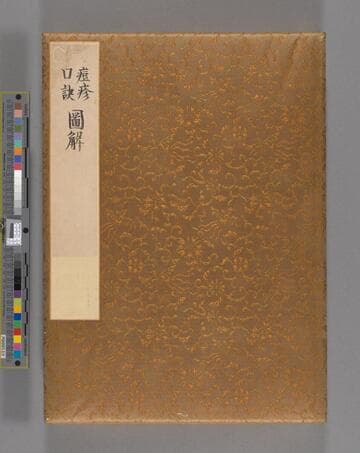
Japanese smallpox manuscript volume, approximately 1860
Manuscripts
Handwritten and illustrated book in Japanese on smallpox. The 29 double pages are mounted to an accordion-style book with stiff pages, and contain 27 hand-colored illustrations, many of which show the disease in three-dimension. The Kanbun text is handwritten. The book is covered in satin brocade with a paper title slip. Housed in a silk folding sleeve, also with paper title slip.
mssHM 82443
Image not available
Billy Blew-Away's alphabetical, orthographical & philological picture book for learners
Rare Books
Child's humorous alphabet book by G.F. Godfrey. Each page is devoted to one letter of the alphabet, with W,X, and Y sharing a page. Each letter is accompanied by words, phrases, and illustrations. An Oct. 7, 1882 review in The Critic (v. 2, no. 46, p. 270) notes that although readers of all ages will be "vastly amused," the book is "unfortunately...marred by a touch of vulgarity."
610394
Image not available
Cuneiform tablet; inventory of grain
Manuscripts
This is an inventory of grain brought probably to the palace or temple. The first two lines give a brief ledger-like statement of this fact; also the date, what is probably April, at the 25th day, but the year is illegible. All the remaining lines contain the names of persons who bought the grain, each is checked at the beginning with a little sign. The cuneiform is probably from about 1200 B.C.; though there is a possibility that it is considerably later.
mssHM 82934