Manuscripts
Fabric samples, Washington family

You might also be interested in
Image not available
Fabric samples, Washington family
Manuscripts
Fabric samples labeled by George Upshur, descendant of George Washington. Samples of fabric and lace from Martha Washington's wedding dress, furniture covering from Mount Vernon, and curtain used by Washington while president in New York and Philadelphia. Includes note and envelope from George Upshur, 1924 July 1.
mssGW
Image not available
George Washington collection
Manuscripts
The bulk of the George Washington collection is correspondence; the collection also contains surveys, military records, memoranda, accounts, receipts, and ephemera. Material dates from 1749 to 1806 and spans Washington's entire adulthood, from his early years as a Virginia surveyor and through his military career to the final days of his presidency. Also present in the collection are Washington family correspondence and material pertaining to Mount Vernon and Washington's household, including several items regarding enslaved laborers. The military material in the Washington collection is primarily correspondence and relates to both the French and Indian and Revolutionary Wars. French and Indian War material pertains to the Virginia Regiment, forts, supplies, funds and soldiers' pay, and relations with Native Americans. Revolutionary War records also include appointments, addresses, orders, returns, commissions, brigade lists, warrants, and congressional resolutions. The bulk of correspondence is between Washington and other generals and military personnel, including Alexander McDougall, James Mitchell Varnum, George Clinton, William Alexander, Elias Dayton, Israel Shreve, and others; many are in the handwriting of his various aides-de-camp and secretaries, including Alexander Hamilton, Tench Tilghman, Robert Hanson Harrison, and Richard Kidder Meade. Revolutionary War letters and documents pertain to military strategy, intelligence, troop movements and expeditions, instructions to generals, and British positions; procurement and supplies, including food and clothing; the relationship with the French; suspected spies; methods of correspondence; and peace. They also relate to the recruitment and enlistment of soldiers, soldiers' conduct, and pardons and executions. In addition, some items refer to civilian behavior and the appropriation of civilian property. Few items relate specifically to Washington's government work during the years of his presidency, other than several items that discuss congressional acts and bills. A small number of documents pertain to the new government's relationship with Native Americans including the Eel River tribe (1793 May 7). The bulk of correspondence from this period are letters to Tobias Lear, Washington's personal secretary, and relate primarily to household matters, including setting up house in Philadelphia, Washington's properties, and tenants and renters. Items also pertain to Potomac Company activities and its river and canal projects around Washington, D.C., in Maryland and Virginia. Also included are several items that discuss the development of the District of Columbia. The collection contains a small amount of personal and family material, including correspondence with Bushrod Washington, George Augustine Washington, and Elizabeth ("Betty") Washington Lewis. There are also several letters from Martha Washington to family members, especially to her niece, Frances (Fanny) Bassett Washington Lear. A 1792 Washington family genealogy includes a narrative and chart.A number of items in the collection pertain to Mount Vernon and the Washington household, including surveys and records of lands granted to Washington and Mount Vernon properties; items relating to farming and crops; and household accounts, bills, receipts, orders, and inventories. Also included are fabric samples of furniture covering from Mount Vernon, and of a curtain used by Washington while president in New York and Philadelphia. Several items in this collection relate to the persons held in slavery by the Washingtons, including an appraisement of enslaved laborers sent to the Dismal Swamp (1764 July 4), letters to Tobias Lear (1791 June 19 and 1794 May 6), and letters (1796 November 28 and December 22) to Joseph Whipple regarding Ona (Oney) Judge, enslaved personal servant of Martha Washington who self-emancipated to New Hampshire.
mssGW
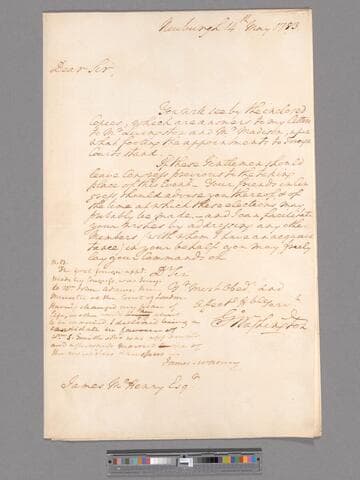
Letter from George Washington, Newburgh, to James McHenry
Manuscripts
Autograph letter signed. Marginal note by McHenry. Includes copies of letters to Washington from James Madison (1783 April 29) and Robert R. Livingston (1783 May 2) in the hand of Martha Washington, endorsed by George Washington.
mssGW
![[Washington family.]](/_next/image?url=https%3A%2F%2Frail.huntington.org%2FIIIF3%2FImage%2F22APN4UYEMHG%2Ffull%2F%5E360%2C%2F0%2Fdefault.jpg&w=750&q=75)
[Washington family.]
Visual Materials
Image of a group portrait of George Washington with his wife, adopted children, and family servant; (left to right) George Washington Parke Custis, George Washington, Eleanor Parke Custis, Martha Washington, and William Lee posed around a table with a sword, map, and book spread out over it.
priJLC_POL_002716
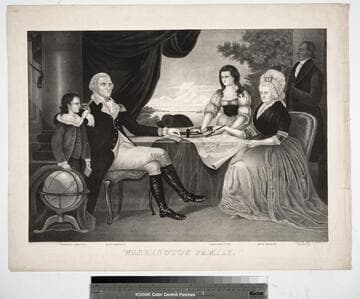
Washington family
Visual Materials
Image of a group portrait of George Washington with his wife, adopted children, and family servant; (left to right) George Washington Parke Custis, George Washington, Eleanor Parke Custis, Martha Washington, and William Lee posed around a table with a sword, map, and book spread out over it.
priJLC_POL_002717
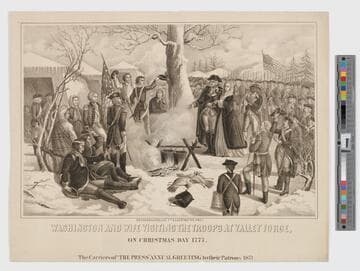
Washington and wife visiting the troops at Valley Forge, on Christmas Day 1777
Visual Materials
Image of George Washington and his wife Martha Washington visiting troops in a wintery camp scene at Valley Forge, Pennsylvania, on Christmas Day, 1777; George Washington stands at center with Martha on his arm and hand extended in greeting; soldiers gathered around a cook fire greet the Washingtons with salutes and raised hats; male African-American slave holds a pair of game birds behind Martha, presumably brought for the soldiers; ranks of soldiers stand at attention in background at right.
priJLC_MIL_001261