Visual Materials
Subseries S. Models: Wood
You might also be interested in
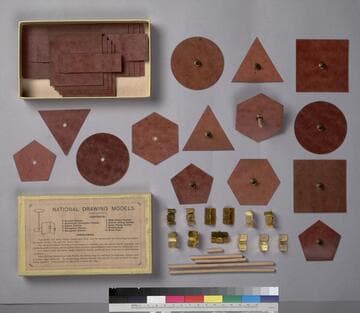
National Drawing Models
Visual Materials
One boxed drawing model set entitled National Drawing Models, manufacturer unknown, ca. 1885-1895. The set is comprised of 30 heavy paper "tablets" in a variety of shapes (circles, triangles, squares, etc.), 12 brass clips, and 6 wooden rods. The tablets attach to each other with brass clips and rods to form representations of solid three dimensional forms. Instructions for use are provided on the box label. The set contains "3 Circular Tablets; 3 Equilateral Triangular Tablets; 6 Square Tablets; 3 Pentagonal Tablets; 3 Hexagonal Tablets; 4 Wide Oblong Tablets; 4 Narrow Oblong Tablets; 4 Small tablets; 7 Wooden Rods; [and] 12 brass clips." The set is almost complete; only one wooden rod is missing. Some of the "tablets" have small brass holders punched through the center, into which the wooden rod is placed. Note: Conservators have removed the items from the original box and have placed them into separate envelopes. The original box remains with the models. DK notes that these were the "poor man's" version of the Froebel gift boxes of cubes and other forms. These paper create-your-own drawing models were commonly used by the less well-funded public schools.
ephKAEE
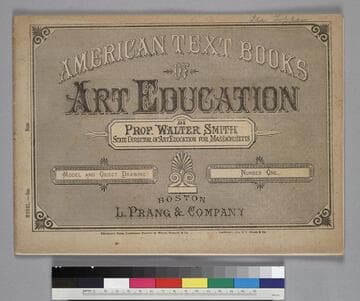
American Text Books of Art Education: Model and Object Drawing, Number One and Number Two
Visual Materials
Two drawing books entitled American Text Books of Art Education: Model and Object Drawing, Number One and Number Two, by Walter Smith, published by L. Prang & Company, Boston, 1875. There are two copies of Number One; one is issued separately, the other bound together with Number Two. This "double issue" has an additional plain paper cover, with a Prang ownership stamp in the upper right-hand corner. On the inside of this additional cover is an ink stamp reading: "Royal B. Farnum, Director Art Education, State of Massachusetts", with "7/6/28" written in ms., in ink, below it. Each of the books is 20 pages in length, and contain numbered exercises. Each exercise is comprised of instructional text, a lithograph image for copying, and space for copying. The books have not been completed by previous owners. Some of the objects and models pictured in the books include: fruit and vegetables, drinking vessels of various kinds, seashells, chairs and geometrical solid forms. On the inside of each of the front covers are directions and instructions for using the books; on the inside of the back covers are illustrated names and definitions of the shapes and forms used throughout, and an advertisement for wooden drawing models. On the back covers are publisher's advertisements for other Smith books.
ephKAEE
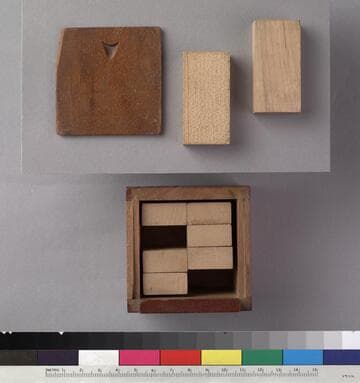
Bradley’s Kindergarten Material, No. 4, Fourth Gift
Visual Materials
One set of wood blocks entitled Bradley's Kindergarten Material, No. 4, Fourth Gift, manufactured by Milton Bradley & Co., Springfield, Massachusetts, ca. 1900. The set is comprised of 8 wooden 1-inch cube blocks, housed inside a wooden box with a sliding lid. A paper label is mounted to the front side of the box; the label bears the title and manufacturer's name. The cubes were used as models for drawing, and were also used in counting and auditory exercises.
ephKAEE
Image not available
Subseries Q. Models: Paper
Visual Materials
This collection contains approximately 700 pieces of ephemera that along with more than 500 separately cataloged books form the Diana Korzenik Collection of Art Education representing the evolution of art education in the United States from mainly 1800 to 1950. The collection was assembled by Massachusetts professor Diana Korzenik over a period of nearly three decades, and the ephemera is composed of instructional materials (e.g. art instruction manuals, art reproductions, drawing books, drawing cards, painting books, penmanship books, etc.), objects (e.g. boxed painting sets, drawing slates, models, drawing desks, colored pencils, crayons, paint, etc.) and non-instructional materials (e.g. promotional materials, scrapbooks, coursework by Korzenik's students, catalogs, etc.). With the exception of the Mabel Spofford archive, which she purchased as a whole, Korzenik pursued each item individually with the aim of assembling frequently overlooked and misunderstood material.
ephKAEE
Image not available
Subseries R. Models: Plaster
Visual Materials
This collection contains approximately 700 pieces of ephemera that along with more than 500 separately cataloged books form the Diana Korzenik Collection of Art Education representing the evolution of art education in the United States from mainly 1800 to 1950. The collection was assembled by Massachusetts professor Diana Korzenik over a period of nearly three decades, and the ephemera is composed of instructional materials (e.g. art instruction manuals, art reproductions, drawing books, drawing cards, painting books, penmanship books, etc.), objects (e.g. boxed painting sets, drawing slates, models, drawing desks, colored pencils, crayons, paint, etc.) and non-instructional materials (e.g. promotional materials, scrapbooks, coursework by Korzenik's students, catalogs, etc.). With the exception of the Mabel Spofford archive, which she purchased as a whole, Korzenik pursued each item individually with the aim of assembling frequently overlooked and misunderstood material.
ephKAEE
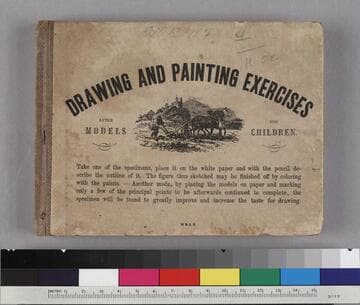
Drawing and Painting Exercises After Models for Children
Visual Materials
One boxed painting set entitled Drawing and Painting Exercises After Models for Children, manufactured by W. & S. B., ca. 1885. The set is comprised of 7 sheets of paper for drawing and painting, a paper palette onto which 6 small round cakes of watercolor paints are mounted, and 11 cutout stencils made from engravings. Also included is one stencil of the initials "OEL." The 11 "specimens" include a woman holding a bowl, a man with an apron full of fruit, and various farm animals. The box that houses these materials is made of light wood and paperboard, and is hinged along the left-hand side, so it opens as a book does. Instructions are printed on the cover: "Take one of the specimens, place it on the white paper and with the pencil describe the outline of it. The figure thus sketched may be finished off by coloring with the paints. - Another mode, by placing the models on paper and marking only a few of the principal points to be afterwards continued to complete, the specimen will be found to greatly improve and increase the taste for drawing." "Orin E. Littlefield, Kittery" is written in ms., in pencil, on the back of the box. The seven sheets of paper contain original and traced artwork. One of the cakes of paint is missing from the palette, and only fragments remain of two others.
ephKAEE