Visual Materials
Circulars of Information of the Bureau of Education, No. 2-1881: The Relation of Education to Industry and Technical Training in American Schools

You might also be interested in
Circulars of Information of the Bureau of Education, No. 4-1882: Industrial Art in Schools
Visual Materials
One pamphlet, copyright 1882, entitled Circulars of Information of the Bureau of Education, No. 4-1882: Industrial Art in Schools, by Charles G. Leland, published by the Government Printing Office, Washington. This pamphlet is 38 numbered pages in length, and is not illustrated. The table of contents is listed on p. 3, and is divided into three sections: Introduction; Practical Teaching; and General Observations. The embossed ownership stamp of the Essex Institute is stamped in the upper right-hand corner of the title page;a Dewey decimal call number is written in ms. on the title page verso.
ephKAEE
Circulars of Information of the Bureau of Education, No. 6-1882: Technical Instruction in France
Visual Materials
One pamphlet, copyright 1882, entitled Circulars of Information of the Bureau of Education, No. 6-1882: Technical Instruction in France, by Bernhard Samuelson, published by the Government Printing Office, Washington. This pamphlet is 64 numbered pages in length, and is not illustrated. The table of contents is on p. 3, and there are 8 appendices. The embossed ownership stamp of the Essex Institute is stamped on the upper right-hand corner of the title page; a Dewey decimal call number is written in ms. on the verso of the title page.
ephKAEE
Circulars of Information of the Bureau of Education, No. 5-1879: American Education as Described by the French Commission to the International Exhibition of 1876
Visual Materials
One pamphlet, copyright 1879, entitled Circulars of Information of the Bureau of Education, No. 5-1879: American Education as Described by the French Commission to the International Exhibition of 1876, by Ferdinand Buisson, published by the Government Printing Office, Washington. This pamphlet is 38 pages in length and is not illustrated. It concerns the findings of a commission of French school officials and teachers who, in 1876, were sent to the United States to study educational methods in connection with the Centennial Exhibition of that year. This pamphlet is a summary of the commission's 702-page report. One of the commission's observations was the match between American values and the school system then in place. The embossed ownership stamp of the Essex Institute is in the upper right-hand corner of the title page. The ink stamp of the Essex Institute, dated March 8, 1880 is stamped in the upper right-hand corner of the front cover.
ephKAEE
Circulars of Information of the Bureau of Education, No. 3-1879: The Value of Common School Education to Common Labor
Visual Materials
One pamphlet, copyright 1879, entitled Circulars of Information of the Bureau of Education, No. 3-1879: The Value of Common School Education to Common Labor, by Edward Jarvis, published by the Government Printing Office, Washington. This pamphlet is 38 numbered pages in length, and is not illustrated. The overall theme of the book concerns the value of education to common laborers. Descriptions of the tasks and work conditions of various types of common labor (including wood splitter, shoveller, and weaver) are given. The crux of the author's argument appears on p. 25: "The value that is created and added to matter by labor is in the ratio of the skill of the worker or the appropriateness of his exertions and the rapidity with which they are made. ... When the mind is torpid, the hand works alone, and for want of a watchful guide it moves in an uncertain manner and with doubtful effect..." The embossed ownership stamp of the Essex Institute is stamped in the upper right-hand corner of the title page. A Dewey Decimal call number is written in ms. on the verso of the title page.
ephKAEE
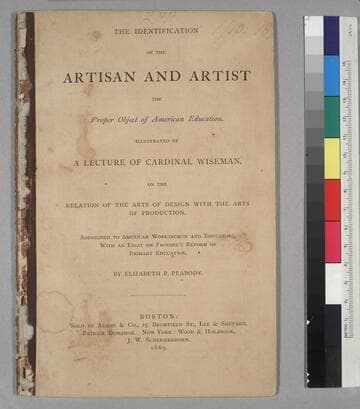
The Identification of the Artisan and Artist: the Proper Object of American Education
Visual Materials
One pamphlet, published 1869, entitled The Identification of the Artisan and Artist: the Proper Object of American Education. Illustrated by a lecture of Cardinal Wiseman, on the relation of the arts of design with the arts of production, by Elizabeth P. Peabody, published(?) by Adams & Co., Boston. The subtitle reads "addressed to American workingmen and educators, with an essay on Froebel's reform of primary education." This pamphlet is 48 numbered pages in length, and is unbound.
ephKAEE
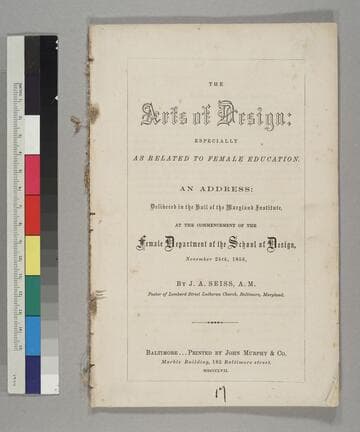
The Arts of Design: Especially as Related to Female Education
Visual Materials
One pamphlet, copyright 1857, entitled The Arts of Design: Especially as Related to Female Education, by J. A. Seiss, published by John Murphy & Co., Baltimore, Maryland. The subtitle reads: "An Address: deliberated in the Hall of the Maryland Institute, at the commencement of the Female Department of the School of Design, November 25th, 1856." The speaker encouraged women to enter the sphere of industrial arts and argued that "the 'Mechanic Arts' would improve both women's lot and the nation's economy." This 28-page pamphlet is unbound and not illustrated.
ephKAEE