Visual Materials
Set of wooden forms circa 1880

You might also be interested in
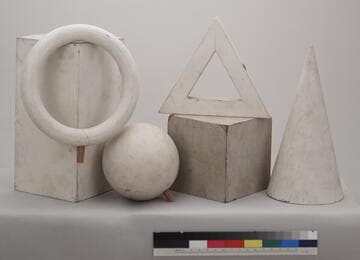
Set of six wooden forms manufacturer unknown, circa 1880
Visual Materials
One set of six wooden forms, untitled, manufacturer unknown, ca. 1880. The set is comprised of a rectangular cube (?), a sphere, a square cube, a ring, an open triangle, and a cone. Each of the forms has either a wooden peg or a peg hole; presumably these forms were fit into a base or each other. All of the forms are painted white. The largest item is the rectangle; it is 8 inches (20.3 cm.) in height and 3 7/8 inches (9.8 cm.) in width; the smallest form is the sphere, which is approximately 3 3/4 inches (9.5 cm.) in diameter. This set may accompany the set in Box 78. Title supplied by cataloger.
ephKAEE
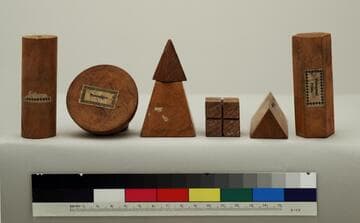
Set of six small, geometric wood models
Visual Materials
One set of six small, geometric wood models. The 6 models are three-dimensional forms, three of which are labeled. They include: "Hexagonal Prism," "Hemisphere," and "Triangular Prism." The other models are a cylinder, a cube, and a pyramid. The cube has been scribed so that it appears to have been made from eight smaller cubes. The top portion of the pyramid can be removed. All the models are small--for example, the triangular prism is 2 7/8" W x 7/8" H (7.5cm x 2.1cm). Title supplied by cataloger.
ephKAEE
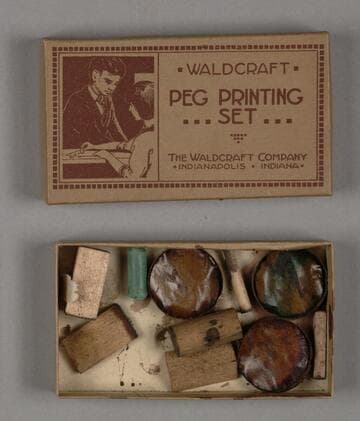
Waldcraft Peg Printing Set
Visual Materials
One boxed dye set entitled Waldcraft Peg Printing Set, manufactured by the Waldcraft Company, Indianapolis, Indiana, ca. 1920. The set is comprised of three dye tins and 6 wooden pegs. The set is housed in a paperboard box; the lid is illustrated with an image of two children using a dye set.
ephKAEE
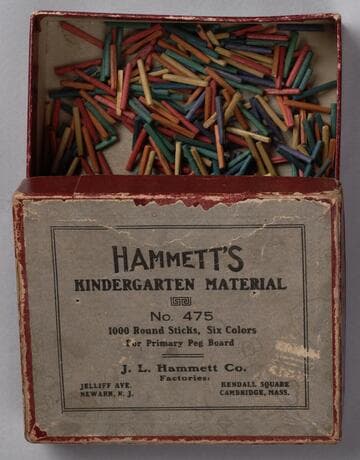
Hammett’s Kindergarten Material - No. 475
Visual Materials
One boxed set of wooden pegs entitled Hammett's Kindergarten Material - No. 475, manufactured by the J. L. Hammett Co., Newark, New Jersey and Cambridge, Mass, ca. 1885. The subtitle reads: "1000 round sticks, Six colors for Primary Peg Board." The set consists of approximately 200 pegs--red, yellow, blue, orange, green and purple--of the original 1000. The pegs are housed within a paperboard box (red) with a gray paper label mounted to the top lid. The pegs are intended for use with peg boards, such as Mrs. B. Putnam's Busy Work Tiles, No. 1 (Box 80, Set 2).
ephKAEE
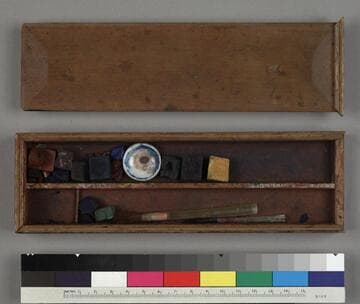
One boxed Set of watercolor paints
Visual Materials
One boxed set of watercolor paints, untitled; manufacturer's name and date are not given. The set is comprised of several small cakes of watercolor paint, one small, round porcelain dish, and two quill paint brushes. The set is housed within a wooden box with a sliding lid. The box is divided into two halves lengthwise by a wooden divider onto which a paper label identifying each color is barely discernible. This box is similar to sets 5 and 10 in Box Number 75. Title supplied by cataloger.
ephKAEE
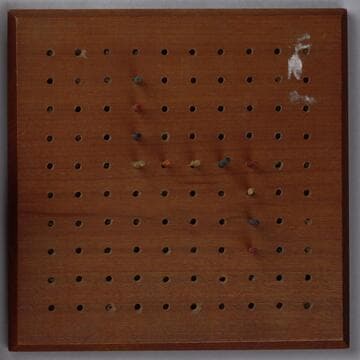
Mrs. B.W. Putnam’s Busy Work Tiles, No. 1
Visual Materials
One wooden peg board entitled Mrs. B.W. Putnam’s Busy Work Tiles, For the Kindergarten, the Primary School, and the Home, No. 1, manufactured by the Milton Bradley Company, Springfield, Massachusetts, ca. 1885. The peg board contains 100 small holes, arranged in 10 even rows of 10 holes each. A paper label, listing the title and manufacturer's name, is mounted to the underside of the board. The peg board was (presumably) used with small wooden pegs such as Hammett's Kindergarten Material - No. 475 (Box 80, Set 1).
ephKAEE